

HeHomoeopathy and Science
Your HeHomoeopathy and Science: Understanding Its Journey and Its Scope in the Futureading
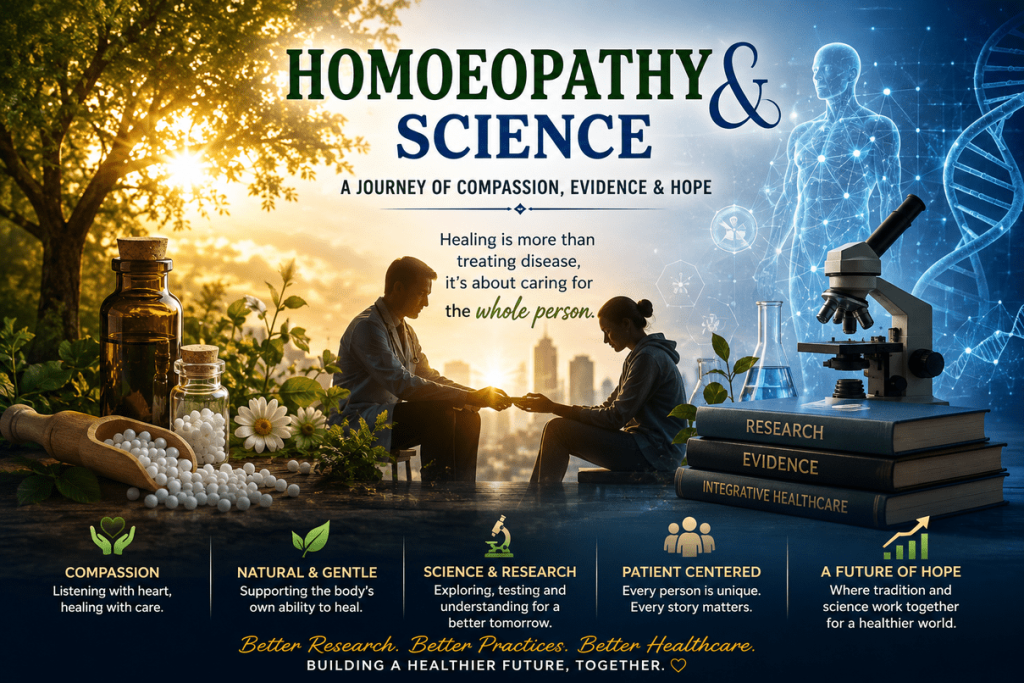
A conversation between tradition, compassion and modern scientific inquiry
For centuries, people have searched for one simple answer to a difficult question:
How can we help a sick human being feel better—not only physically, but also emotionally and mentally?
Medicine has changed enormously over the centuries. From traditional healing practices to modern laboratories, advanced imaging, genetics and artificial intelligence, humanity continues to learn more about the human body.
Within this long history, homoeopathy has developed its own distinctive philosophy of health and healing. Originating in Germany more than 200 years ago, homoeopathy is associated with the principle commonly described as “like cures like” and with the use of highly diluted preparations.
But an important question remains:
Where does homoeopathy stand in the age of modern science—and what could its future look like?
🌿 Homoeopathy: More Than a Medicine Cabinet
For a homoeopathic practitioner, a patient is not simply a diagnosis written on a prescription.
Behind every patient there is a person.
There is a mother who worries about her child.
There is a father who has spent years searching for relief.
There is a young person struggling with anxiety and uncertainty.
There is an elderly person hoping to maintain independence and dignity.
This human side of healthcare is one reason many people are attracted to approaches that emphasize detailed conversations about the individual.
In classical homoeopathic practice, practitioners commonly consider a person’s symptoms, general wellbeing, lifestyle and other individual characteristics when selecting a remedy.
This individualized approach is an important part of the identity of homoeopathy.
However, individualized care should not be confused with scientific proof of effectiveness. Modern medicine requires treatments to demonstrate their benefits through carefully designed research.
🔬 Homoeopathy and Modern Science
Science does not ask us to believe something simply because it is old, popular or personally meaningful.
Science asks questions.
Does it work?
How much does it help?
For whom does it help?
What are the risks?
Can the results be reproduced independently?
These questions are essential for the future of every healthcare system—including homoeopathy.
Current evidence does not provide reliable support that homeopathy is effective for treating any specific health condition, according to the U.S. National Center for Complementary and Integrative Health (NCCIH). The NHS similarly states that there is no good-quality evidence demonstrating effectiveness for any health condition.
This does not mean that the scientific conversation should end.
Quite the opposite.
It means that better research is needed.
High-quality research can help distinguish between genuine treatment effects, placebo effects, natural recovery, changes in lifestyle, and other factors that influence how patients feel.
For homoeopathy to strengthen its position in the future, research needs to be transparent, reproducible and methodologically rigorous.
❤️ The Human Being Behind the Disease
Modern healthcare has achieved extraordinary things.
Antibiotics, vaccines, surgery, emergency medicine, cancer treatments, medical imaging and countless other advances have saved millions of lives.
At the same time, medicine continues to recognize the importance of communication, empathy, lifestyle, mental wellbeing and patient-centered care.
This is where an important lesson can be found.
A patient does not want to feel like a number.
They want someone to listen.
They want their concerns to be understood.
They want their questions answered.
They want their treatment decisions explained honestly.
And above all, they want to be treated with dignity.
Regardless of whether a person chooses conventional medicine, complementary care, or both, these principles should remain at the heart of healthcare.
🌱 What Could Be the Future of Homoeopathy?
The future of homoeopathy should not be based on exaggerated promises.
It should be based on responsibility, research, transparency and patient safety.
There are several areas where homoeopathy and its professional community can develop.
1. More Scientific Research
The first and most important opportunity is research.
Future studies should use:
- Properly designed clinical trials
- Appropriate control groups
- Adequate sample sizes
- Transparent reporting
- Independent researchers
- Reproducible methods
- Long-term follow-up where appropriate
Research should investigate both benefits and limitations.
A mature healthcare field should be willing to accept positive results when the evidence supports them—and negative results when it does not.
2. Better Integration With Healthcare
The future may increasingly involve communication between different healthcare disciplines.
Patients sometimes use complementary approaches alongside conventional healthcare. This makes it important for healthcare professionals to communicate openly about everything a patient is taking.
Patients should never be encouraged to abandon proven treatment for serious conditions in favor of an unproven alternative. NCCIH specifically advises people not to use homeopathy to replace proven conventional care or delay appropriate medical evaluation.
The future should therefore be about cooperation rather than conflict.
3. Digital Healthcare
Technology is changing healthcare rapidly.
Online consultations, electronic patient records, digital appointment systems and health education platforms are becoming increasingly important.
For professional homoeopathic practices, technology can improve:
- Appointment management
- Patient communication
- Follow-up records
- Educational content
- Treatment documentation
- Access to information
But digital healthcare must also protect patient privacy, informed consent and medical safety.
4. Artificial Intelligence and Research
Artificial intelligence could eventually become an important research tool.
AI can help researchers organize large datasets, identify patterns, compare published studies and support evidence synthesis.
However, AI should be used as a tool, not as a replacement for scientific validation or professional clinical judgment.
A computer can identify patterns.
It cannot replace human responsibility.
🌍 A Growing World of Health Information
The internet has changed how people search for health information.
Today, a patient can read about a symptom within seconds.
This creates both an opportunity and a responsibility.
Healthcare websites should provide information that is:
Clear.
Honest.
Evidence-aware.
Easy to understand.
Responsible.
A professional healthcare website should not promise miraculous cures.
Instead, it should educate patients, encourage appropriate medical evaluation, explain available options and help people make informed decisions.
This is especially important because misleading health information can cause people to delay effective treatment.
🌟 The Real Scope of the Future
Perhaps the future of homoeopathy should not be measured simply by asking:
“How many people use homoeopathy?”
A better question might be:
“How responsibly can homoeopathy serve people in a modern healthcare environment?”
Its future will depend on several factors:
Scientific research
↓
Professional education
↓
Quality and safety
↓
Ethical practice
↓
Transparent communication
↓
Patient-centered care
If these principles become stronger, the conversation around homoeopathy can become more constructive and scientifically meaningful.
💚 A Message to Every Patient
When someone walks into a clinic, they don’t bring only a medical problem.
They bring their story.
They bring their worries.
They bring their family.
They bring their hopes.
Sometimes they have already visited several doctors. Sometimes they have spent years looking for answers.
That is why healthcare should never lose its human touch.
A doctor may not always be able to promise a cure.
But a doctor can promise to listen carefully, communicate honestly, respect the patient and encourage appropriate care.
That commitment is more valuable than any exaggerated medical claim.
🔬 The Road Ahead
Homoeopathy has a history spanning more than two centuries, but its future should be determined by what can be demonstrated through responsible research—not simply by tradition or popularity.
Modern science has given humanity powerful methods for understanding health and disease. The challenge for homoeopathy is to engage constructively with those methods.
The future should therefore be a journey toward:
Better Research
Better Education
Better Safety
Better Patient Communication
Better Integration of Healthcare
Greater Transparency
And perhaps this is the most important message:
Healthcare is ultimately about people—not merely diseases.
Whether the future brings new discoveries, new technologies or new models of healthcare, compassion should remain at the center.
Because behind every medical record is a human being hoping for something very simple:
To be heard. To be understood. And to receive the safest and most appropriate care possible.
🌿 Final Thoughts
Homoeopathy’s future remains a subject of scientific debate. Current evidence does not establish homeopathy as an effective treatment for specific health conditions, and responsible practitioners should communicate this honestly.
But the discussion does not need to be hostile.
Science progresses through questions, investigation, evidence and openness to correction.
If homoeopathy is to have a meaningful place in the future, its strongest path forward is not exaggerated promises—it is high-quality research, ethical practice, patient safety and respect for scientific evidence.
The future of healthcare belongs to knowledge, compassion and responsibility.
— MS SH Clinic
For educational purposes only. This article is not a substitute for diagnosis or treatment by an appropriately qualified healthcare professional. Patients with serious, persistent or worsening symptoms should seek appropriate medical evaluation and should not delay proven treatment.